Saturday, September 29, 2007

All Things Science

Creating a web site about dinosaurs, outer space, and the human body should not be a hard task since the topic itself easily grabs peoples’ attention. However, the Berndt Group went above and beyond when developing the Maryland Science Center’s website. At first glance, it is obvious that the developers are well qualified to create eye-catching sites that keep a reader’s interest and are user-friendly. Credit to the web group is given at the bottom of the page, and a link is provided to their site. After clicking around on The Berndt Group’s page, I noticed that they have numerous awards under their belt and have created sites for the National Aquarium of Baltimore, Johns Hopkins Institutions, the Maryland SPCA, and Mercy hospital. Clearly, these people know exactly what they are doing.


I thouroughly enjoyed surfing around the Science Center’s page, and the ease at which I could find what I wanted was helpful. The location of the search bar at the top of the page is perfect for finding those quick ideas that pop into your head. The logo, which also serves as the link to the home page, is cleverly located at the top as well. The shape of the logo and the menu on the home page are both an off-kilter oval, leading viewer’s to make a clear connection. In addition, the core part of the menu follows you on every page and includes common sense headings to allow easy navigation.

The bright colors on the site cater to young children and would easily grab their attention. There is a fun magnifier that dangles next to the pictures on the home page that lets kids discover hidden pictures. Most of the images chosen have a uniform layout. The images on the home page direct the eye by curving into the menu, and the images at the top of each section arch so that attention is drawn to the text below. The paragaphs are short and sweet and don’t lead to lengthy pages. My only suggestion would be to decrease the gap on the right side by centering everything on the page.

I have never thought of going to the Maryland Science Center, although I have passed it many times while strolling around the Inner Harbor. However, after viewing their webpage, I have been persuaded to plan a visit.

--Images from MDSCI.org

Saturday, September 15, 2007

A Dose of Happiness?

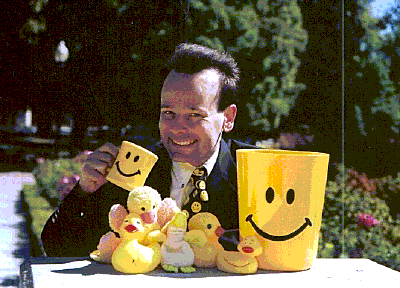
(image from the Happy Guy)


David Leonhardt, the self-proclaimed “Happy Guy,” believes that anyone can find a small dose of happiness with a few clicks around his website. Although I find his website somewhat charming, it is hard to believe that someone in serious need of true happiness will find it on his page. Not to mention that a constant reminder of the author’s published books lead the reader to draw conclusions about the author’s ulterior motives. However, the humor articles on various topics would probably muster a smile for some.


It seems that Mr. Leonhardt is a busy man who works at home and takes on many roles including father, author, speaker, and consumer advocate. Being an author seems to take priority and was probably the motivation for creating his website. The expected audience was most likely a group of easily persuaded readers with a credit card in their hands. Although I strongly want to believe this website’s purpose is to help humanity attain happiness, observation of the numerous references to his books leads me to think otherwise.


After sifting through a few articles, I started to get used to the author’s distinct style of writing, which lies between rambling jokes and a well-told story. I actually enjoyed reading “The Art of Kissing.” I found his point of view on kissing as the world’s greatest sport refreshing, and I liked that he carried it throughout the article. “The Happy Hermit,” in which we see the side of The Happy Guy that works from home, provided quirky tips on how to be stinky and stay married.


The Happy Guy’s website takes small steps toward making the world happy, but I feel it achieves the author’s intended purpose. With the assumption that Mr. Leonhardt’s underlying goal is to interest people in his writing enough for them to want to purchase his books, it is clear that his website is accommodating.

(above image from Google)

Saturday, September 8, 2007

To be Rich


Since I was born in the 80’s, hearing the name Leona Helmsley did not quite ring a bell in my head. However, I could not pass up the opportunity to comment on the life choices of a woman who ultimately left a chunk of her billion dollar fortune to her beloved dog. After enlightening myself with a quick read on Wikipedia and MSNBC, I began to see more clearly how bizarre this woman really was.


It is hard not to believe that money really does make you crazy when discussing Leona Helmsley. Although money can have a positive effect on some, it seems that the prospect of having enormous amounts of money has unfortunately created a “monster” with Mrs. Helmsley. After all, would a woman who left half of her grandchildren $5 million each and the other half squat be entitled to the trophy for world’s best grandmother? In addition, it seems that Mrs. Helmsley adored her Maltese twice as much as her grandchildren since “Trouble” was endowed with $12 million in trust. However, it is nice to see that the majority of her wealth went to charities, where I am sure it will do some good.


I can’t help but wonder what happened in this woman’s lifetime, either in her childhood or adulthood, which made her who she was in the end. Perhaps her home was not full of love, leaving her with the feeling that the only love she could have was for herself. The only thing I really know for sure is that having a great number of caring and supportive people around is much more valuable than a great amount of money. Although it seems outrageous that someone would leave their dog millions of dollars after they die, I can’t help but smile because “Trouble” seems to have been Mrs. Helmsley’s true source of love and so what if the dog is richer than most of Americans?
(images from Google)